
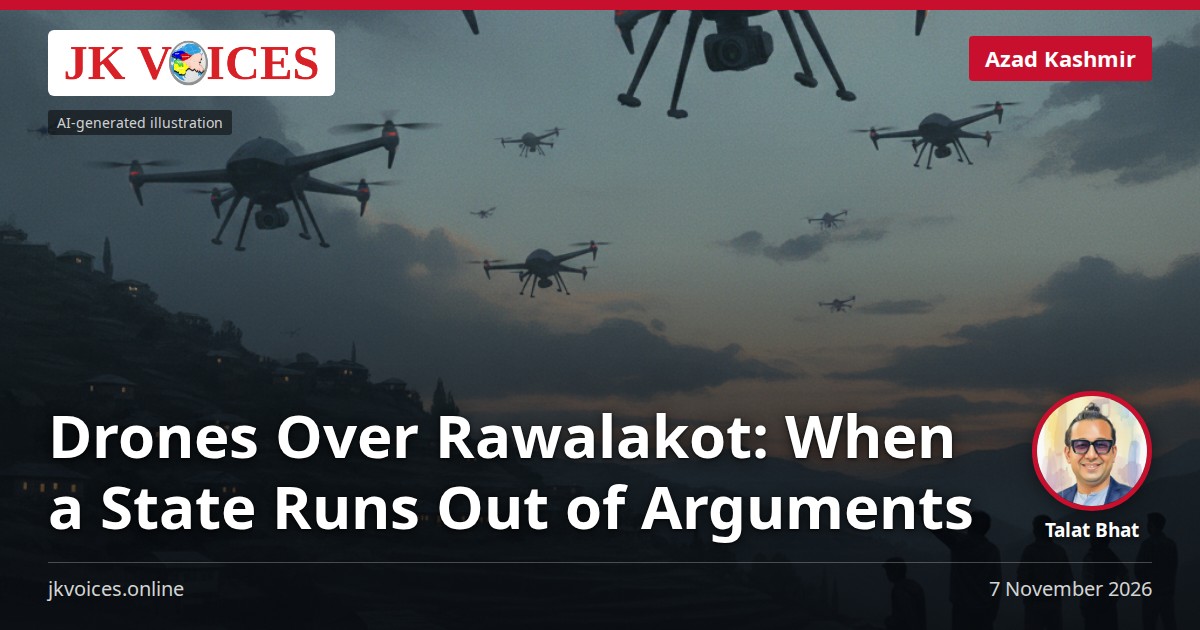
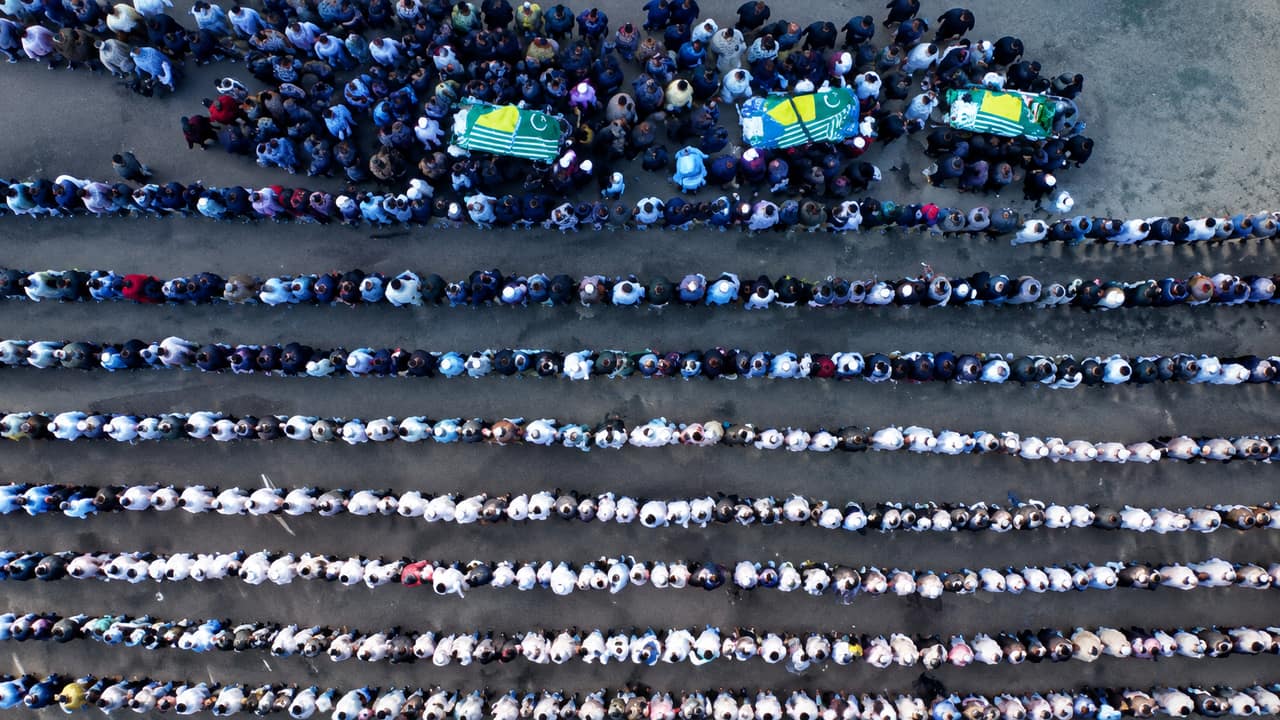
On the morning of 5 November, five months to the day after the ban that was supposed to end it, the sit-in at Rawalakot's Farooq-e-Azam Chowk was attacked from the air. Three young men — Atif, Adil and Ehtesham, whose homes stand a few minutes' walk from the protest — were killed at a checkpoint. A house in Matial Mara was reduced to ash. A woman and several others were wounded. Later in the afternoon, by the account of those on the ground, a medical camp was hit too.
Think about what that sentence means. In the part of The state of Jammu Kashmir that calls itself Azad, a government used drones against its own citizens who were sitting in a square asking for clean drinking water, an MRI machine and a say over their own rivers.
Two days earlier, the Prime Minister of Azad Kashmir had come to Rawalakot and sat with the Rangers, the Frontier Constabulary and the police. He then went home. The people of Rawalakot drew the obvious conclusion. Whatever was discussed in that meeting, it was not a dialogue committee. Nobody was sent to the sit-ins with a message, a warning or an offer. In Islamabad and Muzaffarabad, the President, the Prime Minister and the Speaker tell the cameras that they want talks. On the ground, no committee has been formed, no delegation sent, no process begun.
The story that will not stick
For five months the official narrative has been the same: armed groups, militants, foreign hands, a cypher, India. The Fourth Schedule has swollen past four hundred names. The committee has been declared a terrorist organisation. Its leaders carry 7-ATA and murder charges that make bail impossible.
And yet the narrative keeps colliding with facts the state cannot control. Two days before the strikes, protesters near the bus terminal stopped three men in plain clothes carrying a rifle with an intelligence agency's sticker on it. They were questioned on video, fed, treated as guests, and handed back through a local mediator. Had those men fired and driven away, the evening news would have reported gunfire "from the sit-in". This time they were caught.
Umar Nazir Kashmiri's answer to the accusation of armed groups is disarmingly simple. Switch the internet back on. Let Pakistani and international journalists into Rawalakot. Form a commission with the United Nations and human-rights organisations to investigate every death since 5 June, on both sides. The government, he says, refused outright. A state that is telling the truth does not fear a commission. A state that refuses one has told you what it fears.
The only side that has shown no flexibility is the side with the drones.
Honest journalism must record the other side. Pakistani official media describe the same months as a series of attacks by "armed groups of the banned committee" in which Rangers and police have been killed, and the government says the operation was launched to reopen blocked roads. These claims deserve investigation exactly as much as the protesters' do. That is the whole point. With the internet cut and reporters kept out, nobody has to answer anyone. Restore both and the truth will answer for itself.
Death that is not death
The slogan that so alarms the authorities — sahulatkaro, hum tumhari maut hain, "facilitators, we are your death" — was put to Nazir directly. Who negotiates with death? His reply is worth hearing. The death they mean is political. It is the death of a ruling class that held an election while its opponents were banned and found that people who once queued to vote simply stayed home. It is the death of a system that promised, in writing, on 4 October 2025, to meet thirty-eight demands and then tore up its own signature.
He went further than most movement leaders would. Those killed on the other side, he said, are workers too — poor men sent from every corner of Pakistan as fuel for someone else's war, and their deaths are a grief. The committee has not answered bullets with bullets, and he insists it never will. Whether one believes him or not, that is not the language of a terrorist organisation. It is the language of a political movement asking to be treated as one.
The courts that cannot see
The government's standard advice to the committee is: surrender, drop your demands, and let the courts sort out the rest. Nazir's reply is the case of Shaukat Nawaz Mir. The country watched a police officer arrest him on camera, holding his arm. For over three months Mir has not been produced in court. The same officer has now sworn on oath that he never made the arrest. When a camera is overruled by an affidavit, telling people to trust the courts is not advice. It is mockery.
Why the mediators went quiet
Fazlur Rehman, Hafiz Naeem, Bilawal Bhutto, Senator Mushtaq and local elders all came to Rawalakot, carried proposals back and forth, and then fell silent. Mushtaq was later arrested. The committee says it showed flexibility, accepted middle ways, and wrote three times to Pakistan's Prime Minister and four times to the Field Marshal. Each time the mediators returned to Islamabad, the answer came back the same: no committee, no talks, crush them. Politicians cannot negotiate when the real decision-makers have decided not to.
The way out
It is not complicated, and it has been on the table for months. Restore the internet. Open Rawalakot to the press. Constitute an independent commission with international participation into every death since 5 June. Produce the disappeared in court. Lift the ban and the Fourth Schedule listings so that the movement can do what the government keeps demanding of it — enter the political process. Then sit down and talk about the charter and the broken agreement of October 2025.
The committee says it has no hard line and will accept a middle way. The only side that has shown no flexibility is the side with the drones.
As a Kashmiri who has watched from far away for almost three decades, I know this script. In every part of our divided land — the Valley, Jammu, Ladakh, Gilgit-Baltistan, Azad Kashmir and the diaspora — the state's final argument has always been force, and force has never settled the question. Nazir was asked whether he wants a revolution in a territory with no airport, no currency and no army of its own. His answer was that the revolution has already happened: mothers, sisters and daughters have left their homes and taken their seats in the squares. Nobody who understands Kashmir will doubt that this is the one thing no drone can undo.
Comments (0)